Solar Load Calculator
Calculate your complete solar power system - panels, batteries, and inverter sizing based on your energy needs
Step 1: Energy Assessment
Tell us about your location and energy consumption
Location
Enter the average peak sun hours for your location (typically 3-7 hours)
Energy Consumption
US average: 900 kWh/month. Find this on your electricity bill.
Lighting
Essentials
Climate Control
Kitchen
Laundry
Electronics
Water & Pumps
Personal Care
EV Charging
Other
Step 2: Equipment Selection
Choose how you want to configure your solar system
Your Energy Assessment
Daily Consumption
30 kWh
Required System
7.5 kW
Peak Sun Hours
5.4 hrs
Recommended System Configuration
Solar Panels
17 × 450W
Battery
13.5 kWh
Inverter
6.4 kW Hybrid
System Type
Hybrid
Solar Panels
Battery Storage
Inverter

Step 3: Your Solar System Results
Here's your complete solar power system recommendation
Calculation Results
System Size
7.65 kW
Total panel capacity
Panels Needed
17
450W panels
Battery Storage
13.5 kWh
Usable: 12.15 kWh
Inverter Size
6.4 kW
Hybrid inverter
Annual Production
10,800 kWh
Per year
CO2 Offset
7.6 tons/yr
Environmental impact
Monthly Production
System Specifications
How to Use This Solar Load Calculator
- Select your country/region (11 countries supported) - for US users, choose your state for precise peak sun hours data
- Choose your input method: Enter your monthly kWh from your electricity bill OR select specific appliances you want to power
- Click 'Continue to Equipment Selection' to see your personalized system recommendations
- Choose 'Automatic' mode for our optimized recommendations, or 'Advanced' mode to customize every component
- Review your complete solar system - panels, battery, inverter, annual production, and environmental impact
- Print your results to share with solar installers for accurate quotes
Example: A California home using 900 kWh/month: Select United States → California (5.4 peak sun hours) → Enter 900 kWh → The calculator recommends 17 × 450W panels (7.65 kW system), 13.5 kWh battery, and 6.4 kW hybrid inverter producing ~10,800 kWh annually.
Tip: Use the 'Select Appliances' method if you're planning for specific backup needs during outages - it calculates both daily usage AND peak surge requirements for proper inverter sizing.
Why Use This Advanced Solar Calculator?
Our solar load calculator goes beyond basic sizing. It's a complete system design tool that considers your location, consumption patterns, equipment preferences, and backup needs to recommend a properly balanced solar installation.
- Planning a residential or small commercial solar installation and need accurate system sizing
- Want to verify quotes from solar installers against independent calculations
- Need to calculate backup power requirements for specific appliances during outages
- Comparing grid-tied vs. hybrid vs. off-grid system configurations
- Evaluating different panel wattages (400W-550W) and their roof space requirements
- Understanding how location-specific peak sun hours affect system size and production
- Calculating environmental impact and CO2 offset for sustainability reporting
- Planning for future loads like EV charging or heat pump installation
Understanding Your Solar System Results
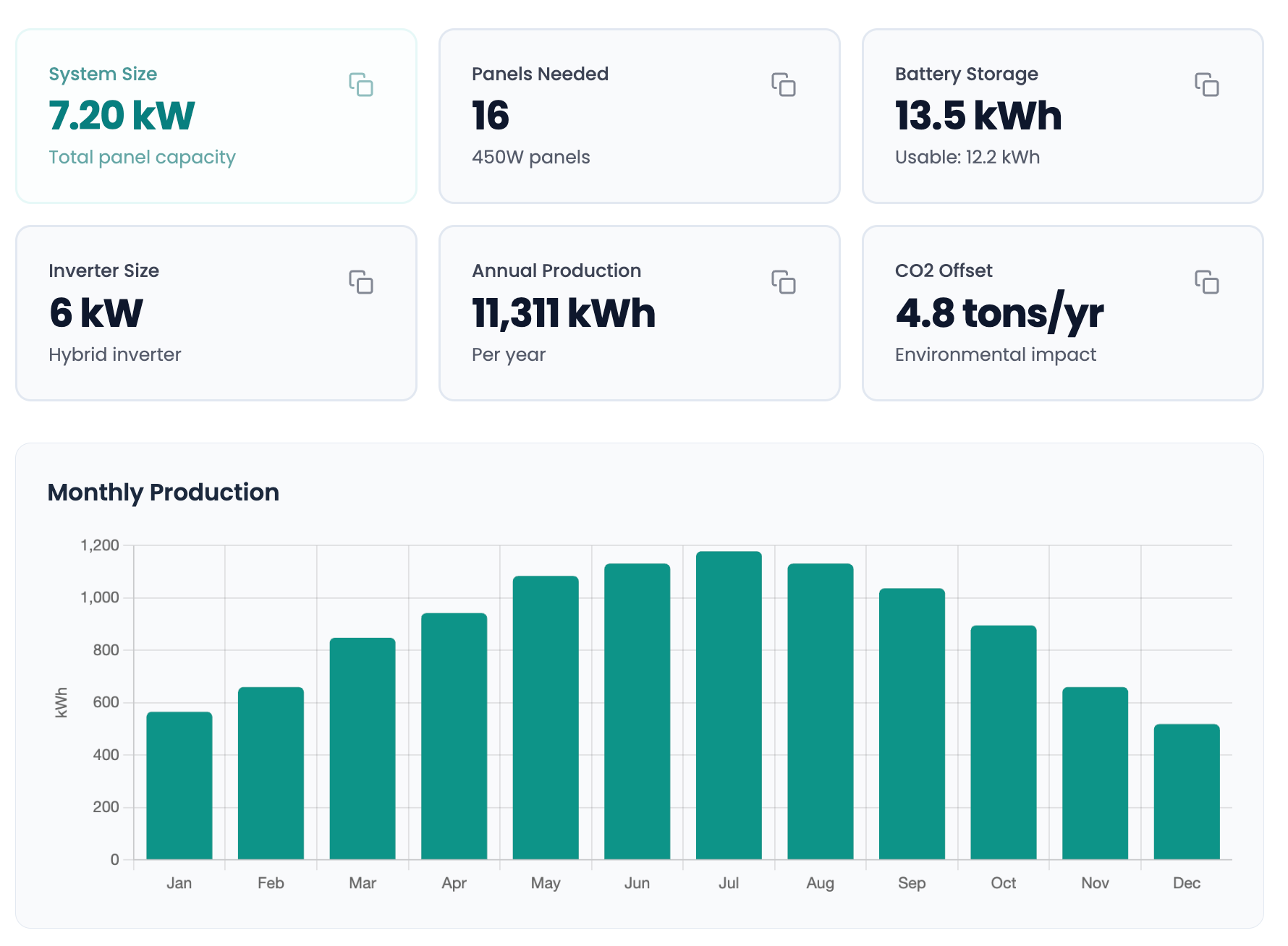
Your results include a complete system specification with six key metrics, a monthly production chart showing seasonal variations, and a detailed specifications table you can print for installer quotes.
| Result | Meaning | Action |
|---|---|---|
| System Size (kW) | Total DC power capacity of your solar array. Calculated as (Daily kWh ÷ Peak Sun Hours ÷ 0.80 efficiency). Typical homes need 5-12 kW. | This determines your roof space needs (~20 sq ft per panel) and serves as the baseline for all other components. |
| Panels Needed | Number of solar panels based on your chosen wattage. Our calculator defaults to 450W high-efficiency panels for optimal price-to-performance. | Higher wattage panels (500W-550W) reduce panel count but cost more. Consider roof space constraints when choosing. |
| Battery Storage (kWh) | Energy storage capacity for backup power and load shifting. Usable capacity is 90% of rated (depth of discharge limit). | Auto mode recommends 13.5 kWh (similar to Tesla Powerwall) for 2 days of essential load backup. Adjust based on your outage frequency. |
| Inverter Size (kW) | The power electronics that convert DC solar to AC household power. Sized for a 1.2:1 DC-to-AC ratio for optimal production. | Hybrid inverters recommended for battery systems; string inverters for grid-tied; microinverters for shaded or complex roofs. |
| Annual Production (kWh) | Estimated yearly electricity generation: System kW × Peak Sun Hours × 365 × 80% efficiency. Varies by season. | Compare to your annual usage. A 100%+ offset means potential net metering credits; 80-90% is often most cost-effective. |
| CO2 Offset (tons/year) | Environmental impact based on 0.855 lbs CO2 per kWh (US grid average). Your carbon footprint reduction. | A 7 kW system typically offsets 7-8 tons of CO2 annually - equivalent to planting ~120 trees or driving 17,000 fewer miles. |
Meaning: Total DC power capacity of your solar array. Calculated as (Daily kWh ÷ Peak Sun Hours ÷ 0.80 efficiency). Typical homes need 5-12 kW.
Action: This determines your roof space needs (~20 sq ft per panel) and serves as the baseline for all other components.
Meaning: Number of solar panels based on your chosen wattage. Our calculator defaults to 450W high-efficiency panels for optimal price-to-performance.
Action: Higher wattage panels (500W-550W) reduce panel count but cost more. Consider roof space constraints when choosing.
Meaning: Energy storage capacity for backup power and load shifting. Usable capacity is 90% of rated (depth of discharge limit).
Action: Auto mode recommends 13.5 kWh (similar to Tesla Powerwall) for 2 days of essential load backup. Adjust based on your outage frequency.
Meaning: The power electronics that convert DC solar to AC household power. Sized for a 1.2:1 DC-to-AC ratio for optimal production.
Action: Hybrid inverters recommended for battery systems; string inverters for grid-tied; microinverters for shaded or complex roofs.
Meaning: Estimated yearly electricity generation: System kW × Peak Sun Hours × 365 × 80% efficiency. Varies by season.
Action: Compare to your annual usage. A 100%+ offset means potential net metering credits; 80-90% is often most cost-effective.
Meaning: Environmental impact based on 0.855 lbs CO2 per kWh (US grid average). Your carbon footprint reduction.
Action: A 7 kW system typically offsets 7-8 tons of CO2 annually - equivalent to planting ~120 trees or driving 17,000 fewer miles.
Note: Results assume unshaded, optimally-oriented roof installation. Actual production varies ±15% based on weather, shading, panel degradation, and system maintenance. The monthly production chart shows seasonal variation - expect 20-25% higher output in summer vs. winter.
How This Solar Load Calculator Works
This calculator uses a three-step wizard to design your complete solar power system. In Step 1 (Energy Assessment), you can input your energy needs using either your monthly electricity bill in kWh or dollars, or by selecting from over 25 categorized appliances including essentials like refrigerators and lights, climate control equipment, kitchen appliances, laundry machines, electronics, water heaters and pumps, and EV chargers. The appliance method is especially valuable for sizing backup systems during outages because it calculates both daily consumption and peak surge requirements - critical for proper inverter sizing since motors in AC units, refrigerators, and pumps draw 2-3× their rated wattage at startup.
Step 2 (Equipment Selection) offers two modes: Automatic mode recommends optimally balanced equipment including 450W high-efficiency panels, 13.5 kWh battery storage for 2 days of backup, and a hybrid inverter sized at a 1.2:1 DC-to-AC ratio. Advanced mode gives you full control to customize panel wattage (400W to 550W), panel count with real-time roof space calculations, battery capacity (0-30 kWh), days of autonomy (1-5 days), and inverter type (String, Hybrid, or Microinverters).
Step 3 displays your complete results including six key metrics, a monthly production chart showing seasonal variation, and a detailed specifications table you can print for installer quotes.
The calculator includes location-specific Peak Sun Hours for 11 countries, with US state-by-state precision from NREL data - Arizona leads at 6.57 hours while Washington averages 3.57 hours. You can choose between Grid-Tied systems (lowest cost, no backup during outages), Hybrid systems (grid-connected with battery backup, most popular for residential), or Off-Grid systems (complete energy independence requiring larger battery banks).
The current 30% Federal Investment Tax Credit through 2032 applies to all components including panels, batteries, inverters, and installation labor. For related calculations, use our estimate power bills to estimate your current energy expenses, or check the size your AC or heater for HVAC sizing that impacts your overall energy consumption.
Formula
System Size (kW) = Daily Energy (kWh) ÷ (Peak Sun Hours × System Efficiency) Where Daily Energy = Monthly kWh ÷ 30 (or calculated from selected appliances), Peak Sun Hours are location-specific (ranging from 3.0 in Seattle to 6.6 in Arizona), and System Efficiency accounts for real-world losses (temperature derating, wiring losses, inverter conversion, soiling) typically totaling 80%.
Current Standards: Calculations follow NREL PVWatts methodology using National Solar Radiation Database (NSRDB) data. System efficiency factors align with California Energy Commission guidelines. Battery sizing follows NABCEP best practices for depth of discharge and days of autonomy.
Frequently Asked Questions
How accurate are these solar system size recommendations?
Our calculations are within ±10% of professional software like PVWatts, Aurora, and Helioscope when using accurate inputs. The key variables are your actual electricity usage (from 12 months of bills for best accuracy), your location's peak sun hours (we use NREL data), and system efficiency (we use industry-standard 80%). However, site-specific factors like roof orientation, tilt angle, and shading require a professional site assessment to refine the estimate.
What's the difference between Automatic and Advanced mode?
Automatic mode uses our optimized defaults: 450W high-efficiency panels, 13.5 kWh battery storage, hybrid inverter, and 2 days of backup autonomy. It's ideal for most homeowners wanting a balanced system. Advanced mode lets you customize every component - useful if you have specific constraints (limited roof space requiring 550W panels), budget limits (grid-tied without battery), or unique requirements (off-grid with 5-day autonomy). Both modes calculate the same core metrics.
Why does the calculator ask about individual appliances?
The appliance selection method serves two purposes: First, it calculates accurate daily energy consumption for users who don't have utility bills (new construction) or want to size for specific backup loads. Second, it determines peak surge power - motors in refrigerators, AC units, and pumps draw 2-3× their rated wattage at startup. This surge requirement is critical for sizing inverters that won't overload or shut down when multiple appliances start simultaneously.
How many solar panels fit on my roof?
Each residential solar panel occupies approximately 17.5-20 square feet (3.25' × 5.5' typical dimensions). Our calculator shows estimated roof space needs based on your panel count. A 20-panel system needs roughly 350-400 sq ft of unobstructed, south-facing roof. Subtract areas around vents, skylights, and chimneys. East/west facing roofs work but reduce production 10-15%. North-facing is not recommended in the Northern Hemisphere.
What battery size do I need for whole-home backup?
Whole-home backup during a typical outage requires 20-30+ kWh of battery storage. Here's why: A 3-ton AC draws 3,500W × 6 hours = 21 kWh/day alone. Add refrigerator (1.2 kWh), lights (0.5 kWh), and essentials (~2 kWh), and you're at 25+ kWh daily. For 2-day backup, you'd need 50+ kWh of storage. Most homeowners instead choose 'essential load' backup (10-15 kWh) covering refrigerator, lights, outlets, and internet during outages.
What are peak sun hours and how do they affect system size?
Peak Sun Hours (PSH) represent hours of 1000 W/m² solar irradiance - the standard used to rate panels. A 400W panel produces 400 Wh during one peak sun hour. Arizona's 6.5 PSH means that 400W panel produces 2,600 Wh (2.6 kWh) daily. The same panel in Seattle (3.5 PSH) produces only 1,400 Wh (1.4 kWh). This directly affects system size: Seattle needs nearly twice the panels as Phoenix for the same output.
Should I choose grid-tied, hybrid, or off-grid?
Grid-tied is most cost-effective if you have reliable utility power and net metering - skip the battery and let the grid store your excess. Hybrid is best for areas with frequent outages, time-of-use rates where batteries shift usage, or energy independence goals - you get backup power plus grid benefits. Off-grid is only necessary where utility connection is impossible or prohibitively expensive (>$15,000 to connect). Off-grid requires 3-5× more battery capacity and often a backup generator.